


Our services include:
- Comprehensive fertility care for patients with:
- General or unexplained infertility
- Endometriosis-associated infertility
- Recurrent miscarriage management
- Ovulation disorders, including PMOS
- Male factor infertility
- Fertility preservation, including egg freezing (oocyte vitrification)
- Preimplantation genetic testing (PGT)
- Donor conception, with a special interest in caring for single women and same-sex couples
- Reproductive care for transgender and gender diverse people
- Surrogacy
Fertility Care Tailored to Your Needs
Getting started on your fertility journey may involve a number of appointments to ensure your care and treatment plan are tailored to your individual needs:
- Referral from your GP To schedule an appointment with a fertility specialist at Heide Clinic, you will need a referral from your GP. If you have a partner, their details should be included on the referral.
- Consultation with your fertility specialist During your initial consultation, your medical and fertility history will be reviewed and your specialist will discuss appropriate investigations and treatment options. If you have a partner, they may also be encourage to attend. Further testing may be recommended for you or your partner before deciding on the most appropriate next steps. Depending on your circumstances, this may include fertility treatment such as IVF.
- Your fertility treatment plan If fertility treatment is recommended, your specialist will develop a personalised treatment plan and guide you through the next steps. This may include coordination with other fertility healthcare professionals and services involved in your care. Throughout your fertility journey, the focus in on providing personalised, compassionate and coordinated care based on your individual circumstances and goals.
Understanding Each Stage of Your IVF Cycle
The IVF process typically spans approximately two weeks, though individual experiences may vary based on personal circumstances and medical history.
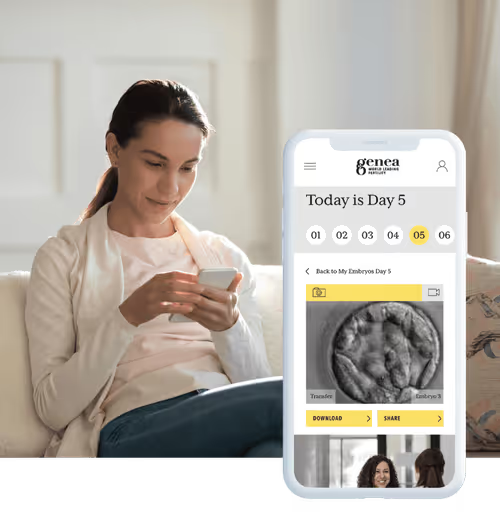
Here’s an overview of a standard IVF cycle
- Starting treatment and monitoring
A blood test will confirm whether your body is ready to start treatment. You will then commence daily fertility medication, usually a form of Follicle Stimulating Hormone (FSH), which stimulates the ovaries to develop multiple follicles and eggs. After several days, you may commence an additional daily medication to help prevent premature ovulation. Throughout this stage, you will attend regular monitoring appointments with your fertility provider. These usually involve blood tests to monitor hormone levels and ultrasounds to assess follicle development. Your fertility provider will advise you when and where these appointments will take place. - Egg collection a fertilisation
Once your follicles have developed appropriately, you will be given medication to trigger the final maturation of the eggs. Your egg collection will then be scheduled, usually around 36 hours later. The collected eggs are taken to the laboratory, where suitable eggs are fertilised using sperm. Your fertility provider will discuss the most appropriate fertilisation method for your individual circumstances. - Embryo development
Following fertilisation, the embryos are carefully cultured and monitored in the laboratory, usually for up to five or six days. The embryology team will assess embryo development during this period and determine which embryos are suitable for transfer, freezing or, where appropriate, further testing. - Embryo transfer and freezing
If a fresh embryo transfer is planned, an embryo may be transferred into your uterus several days after egg collection. This is generally a straightforward procedure performed using a fine catheter and usually does not require an anaesthetic. Any additional suitable embryos may be frozen (vitrified) for potential use in a future treatment cycle. - Pregnancy test Following embryo transfer, your fertility provider will arrange a blood test to determine whether pregnancy has occurred. The timing of this test will depend on your individual treatment plan and the type of embryo transfer performed.
Additional testing - Preimplantation Genetic Testing (PGT) may sometimes be recommended by your specialist as part of your treatment plan. PGT involves taking a small sample of cells from an embryo, usually when it has developed to the blastocyst stage around Day 5 or 6. The sample is sent to a specialised laboratory for genetic testing, while the embryo is frozen and stored. Once the results are available, your fertility specialist will discuss the findings with you and plan an embryo transfer where appropriate.
Your fertility care options
At Heide Clinic, patients have a choice of fertility specialists and fertility providers, allowing you to select the option that best suits your individual needs and preferences.
Dr Samantha Mooney
Sam providers fertility consultations at Heide Clinic and works in partnership with Genea Fertility for fertility treatment and IVF services.
Learn more about Genea Fertility here
Dr Pinar Cingiloglu
Sam providers fertility consultations at Heide Clinic and works in partnership with Newlife IVF for fertility treatment and IVF services.
Learn more about Newlife IVF here
Begin your care with Heide
Get in touch today to schedule your consultation, ask questions, or learn more about our services.
FAQs
Some of our most asked questions.


